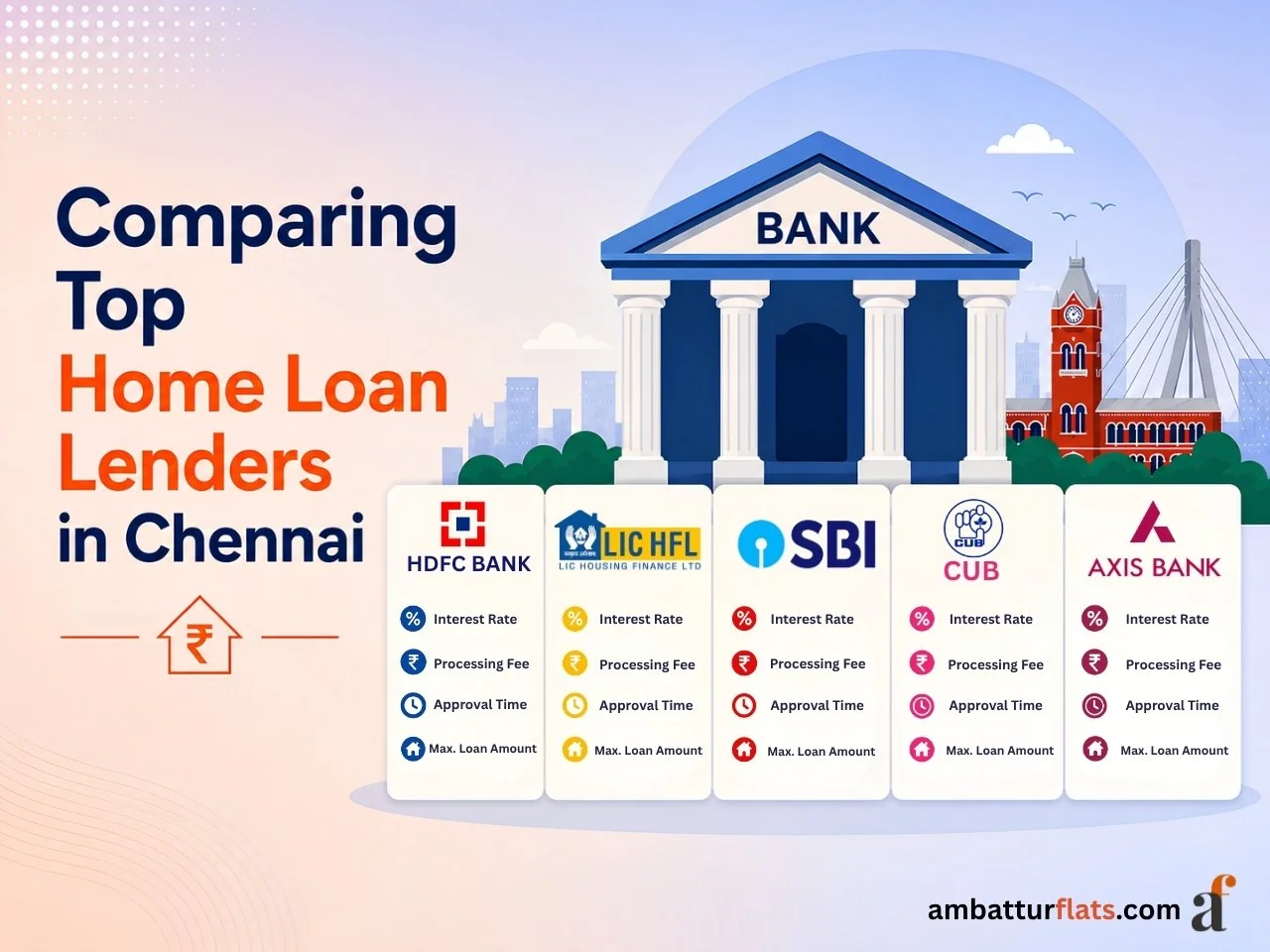
Best Home Loan Lenders in Chennai

[DISCLAIMER]: Interest rates, processing fees, and bank lending policies are subject to periodic updates based on RBI repo rate revisions and individual lender decisions. Please verify current terms directly with the bank before applying.
Selecting the right financial institution for a home loan in Chennai is one of the most critical financial decisions a property buyer will make. While the primary parameter for most buyers is the interest rate, long-term borrowing satisfaction depends equally on processing timelines, legal documentation scrutiny, fee transparency, and post-disbursement customer support.
In the Chennai real estate ecosystem, buyers generally choose between public sector banks (PSUs), private commercial banks, and Housing Finance Companies (HFCs). Public sector institutions often lead with competitive floating interest rates linked directly to external benchmarks, whereas private banks and HFCs typically offer superior digital onboarding, faster turnaround times, and dedicated doorstep execution services. Navigating these tradeoffs requires a grounded understanding of how each lender operates within the local market. For a complete macro perspective on property financing in the city, consult our comprehensive home loan guide for Chennai buyers.
Benchmark Rates: Floating home loan rates across major Chennai lenders currently start between 7.25% p.a. and 8.75% p.a. for prime borrower profiles.
Processing Timelines: Sanction turnaround times vary from 3 to 7 working days for private banks and up to 15 to 21 working days for public sector banks.
Processing Fee Caps: Standard processing fees range from 0.25% to 0.50% of the loan amount, with fixed caps or seasonal waivers frequently offered by major lenders.
Loan-to-Value (LTV) Limits: Statutory RBI guidelines limit financing to 90% for loans up to ₹30 lakh, 80% for loans between ₹30 lakh and ₹75 lakh, and 75% for loans exceeding ₹75 lakh.
Prepayment Flexibility: Floating-rate housing loans to individual borrowers carry zero prepayment or foreclosure penalties across all RBI-regulated institutions.
Understanding the structural differences between lender categories helps align your personal priorities—whether cost minimization or rapid execution—with the right institution.
Public sector banks offer some of the most competitive interest rates in the market because their lending margins are tightly tied to their External Benchmark Lending Rate (EBLR). They are particularly thorough during legal and technical property verification, which provides buyers with an added layer of security regarding title clarity. However, PSU banks often require physical branch visits, feature rigid underwriting rules, and operate with longer turnaround times.
Private lenders prioritize speed, minimal paperwork friction, and digital execution. They utilize automated risk assessments and centralized processing cells, enabling sanctions in as few as 72 to 96 hours for pre-approved or salaried profiles. While their starting interest rates and processing charges can be slightly higher than PSUs, their customer service responsiveness and streamlined disbursement procedures make them popular among time-sensitive buyers.
HFCs operate under National Housing Bank (NHB) regulations and tend to display greater flexibility when evaluating non-standard income profiles, such as self-employed individuals or those with unique cash flow structures. Legal verification protocols at established HFCs are rigorous, particularly for standalone homes and independent plots. Their turnaround times generally fall midway between private and public banks.
Interest Rate Range: 7.25% – 8.45% p.a. (linked to EBLR)
Processing Fees: Typically 0.35% of the loan amount plus GST (subject to promotional fee waivers)
Best Suited For: Cost-conscious buyers, central/state government employees, and buyers purchasing in large, established townships.
Key Advantage: Unmatched branch distribution across Chennai and low ongoing administrative charges.
Interest Rate Range: 7.75% – 9.25% p.a.
Processing Fees: Up to 0.50% of loan amount or ₹3,300, whichever is higher
Best Suited For: Salaried IT/corporate professionals who require fast processing and minimal physical branch visits.
Key Advantage: Extensive list of Approved Project Loans (APL) across major corridors in Chennai, enabling near-instant property-level approvals.
Interest Rate Range: 8.50% – 9.65% p.a.
Processing Fees: 0.50% to 1.00% of loan amount depending on profile
Best Suited For: Applicants seeking end-to-end digital processing and pre-approved home loan offers.
Key Advantage: Streamlined mobile banking integration for tracking disbursement stages and downloading annual interest certificates.
Interest Rate Range: 8.75% – 9.50% p.a.
Processing Fees: Flat fee slabs starting around ₹10,000–₹15,000 depending on loan ticket size
Best Suited For: Self-employed applicants, buyers requiring longer repayment tenures, or those purchasing resale properties.
Key Advantage: Pragmatic documentation evaluation for non-traditional income sources.
Interest Rate Range: 8.35% – 10.05% p.a.
Processing Fees: Up to 1.00% of loan amount (minimum ₹10,000)
Best Suited For: Borrowers seeking specialized product features, such as EMI waiver schemes for regular repayments or custom top-up loan options.
Key Advantage: Highly accessible doorstep customer service during the application and legal vetting phases.
Before finalizing a lender based solely on promotional headline rates, buyers should analyze how individual financial parameters affect real-world offers by comparing interest rates across lenders.
Lending efficiency in Chennai is deeply intertwined with local administrative and geographical dynamics. Evaluating these factors beforehand prevents unexpected delays prior to property registration:
Approved Project List (APL) Status: Major banks maintain an internal registry of vetted builder developments across key micro-markets such as OMR, Porur, Velachery, and Anna Nagar. If a residential project is already on a bank's APL, legal and technical clearance for individual units is bypassed, shortening disbursement from weeks to days.
CMDA and DTCP Legal Scrutiny: Chennai's urban planning framework relies strictly on approvals from the Chennai Metropolitan Development Authority (CMDA) or the Directorate of Town and Country Planning (DTCP). PSU legal empanelment officers examine parent documents, layout approvals, and completion certificates with extreme rigor. While this can extend approval times, it offers strong protection against unapproved constructions.
Branch & Valuation Panel Reach: Having localized legal advocates and technical engineers on a bank’s panel within specific suburban corridors ensures prompt physical site inspections and faster valuation report submissions.
Homebuyers frequently experience acute anxiety during the mortgage selection phase. The fear of encountering hidden administrative costs, unexpected interest rate hikes after the initial period, or operational bottlenecks that cause missed builder payment deadlines can turn what should be an exciting milestone into a stressful endeavor.
Much of this friction stems from information asymmetry. Buyers worry that choosing an overly bureaucratic bank will stall property registration, risking the loss of booking advances. Conversely, there is a fear that opting for a fast-processing lender might mean paying higher interest over a 20-to-30-year tenure. Recognizing that no single bank is universally "best"—and matching your specific priorities (speed vs. cost) to a lender's operational strengths—alleviates this uncertainty.
Selecting the ideal lender requires evaluating your professional profile, credit history, and transaction timelines against bank policies:
High Credit Score Applicants: If your CIBIL score is 750 or above, you command maximum bargaining power. PSU banks like SBI offer their lowest tier rates to high-score applicants. Review minimum credit score requirements to ensure your profile qualifies for top-tier pricing.
Time-Sensitive Purchases: If you are purchasing a resale property or a builder unit with tight payment deadlines, opt for top private lenders (HDFC Bank or ICICI Bank) due to their rapid technical and legal clearance cycles.
Self-Employed & Non-Standard Income Profiles: If your income includes variable business receipts or non-salaried components, HFCs like LIC Housing Finance or specialized private bank desks offer flexible underwriting frameworks.
Document Preparation: Ensure all tax returns, bank statements, property title chains, and approval plans are compiled in advance. Reviewing the necessary loan documentation ahead of time accelerates loan sanctioning regardless of the bank you select.
Complete Home Loan Guide for Chennai Homebuyers
Compare Home Loan Interest Rates Across Banks
CIBIL Score Needed for Home Loan Approval
Complete Checklist of Documents Required for a Home Loan